New Local Sales Tax Rules for Sales Delivered to Philadelphia and Allegheny Counties
Pennsylvania vendors have a new layer to account for when it comes to sales tax. Act 21 of 2026 changes how local sales tax is collected on taxable products and services delivered to customers in Philadelphia and Allegheny counties—and the shift is bigger than it might first appear.
Key Takeaways
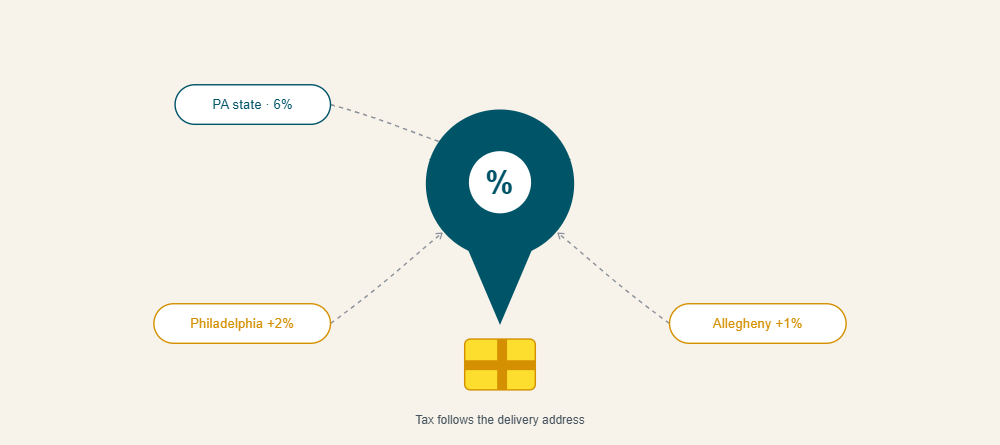
- Vendors delivering taxable sales into Philadelphia County must now collect an additional 2% local tax.
- Vendors delivering taxable sales into Allegheny County must now collect an additional 1% local tax.
- Local tax is now based on where the product or service is delivered, not where the vendor is located.
- The law applies retroactively to tax years beginning after December 31, 2025, though enforcement doesn’t start until October 1, 2026.
What is changing?
If you already collect Pennsylvania’s 6% state sales tax, you’ll now also need to collect and remit:
- An additional 2% Philadelphia local sales tax on taxable sales delivered to Philadelphia County; and
- An additional 1% Allegheny County local sales tax on taxable sales delivered to Allegheny County.
The law was enacted in July and applies retroactively to tax years beginning after December 31, 2025. The Pennsylvania Department of Revenue won’t begin enforcing the new requirements until October 1, 2026, giving vendors time to update their systems and processes. That said, we recommend beginning to collect and remit the applicable local taxes as soon as you’re able—waiting until the enforcement date isn’t the same as waiting until the law takes effect.
What is different?
Previously, local sales tax in Pennsylvania generally followed the vendor’s location—the point of sale. Under the new rules, local sales tax follows the point of destination: where the product or service is actually delivered. This brings local tax administration in line with how Pennsylvania already administers its state sales tax.
In practice, this means a vendor located outside Philadelphia or Allegheny County may still owe local tax if the sale is delivered into one of those counties. Location alone no longer tells the whole story.
What hasn’t changed?
- If sales tax isn’t collected at the time of purchase, the purchaser may still owe use tax when the taxable product or service is used in Philadelphia or Allegheny County.
- Pennsylvania’s 6% state sales tax still applies to taxable products and services.
- State and local use tax rules are unchanged.
Key points
A few points worth repeating as you talk this through with your business:
- Purchasers may still owe use tax if a vendor doesn’t collect the applicable sales tax.
- The applicable local tax depends on the customer’s delivery destination, not necessarily the vendor’s location.
- Taxable sales delivered to Philadelphia are subject to the 6% state tax plus the 2% Philadelphia local tax.
- Taxable sales delivered to Allegheny County are subject to the 6% state tax plus the 1% Allegheny County local tax.
- The law is retroactive, even though enforcement doesn’t begin until October 1, 2026.
- Sales-tax collection and reporting processes need to reflect the new destination-based rules.
Final Recommendation
Don’t wait for the October 1, 2026 enforcement date to make changes. Because the law is retroactive, the sooner your systems reflect the correct destination-based rates, the less cleanup you’ll have later. If you sell into Philadelphia or Allegheny County, now’s the time to review your point-of-sale and invoicing systems.
Source: PA Department of Revenue, Local Sales Tax
Disclaimer: This article is for informational purposes only and does not constitute legal or tax advice. Always consult a qualified professional for guidance specific to your situation.
Questions about Sales Tax?
Reach out to your Simon Lever advisor—we’re happy to walk through what this means for your specific sales footprint.
Questions about Sales Tax?

Mike Stoltzfus, CPA, MST
Learn More About Our Services
"*" indicates required fields